
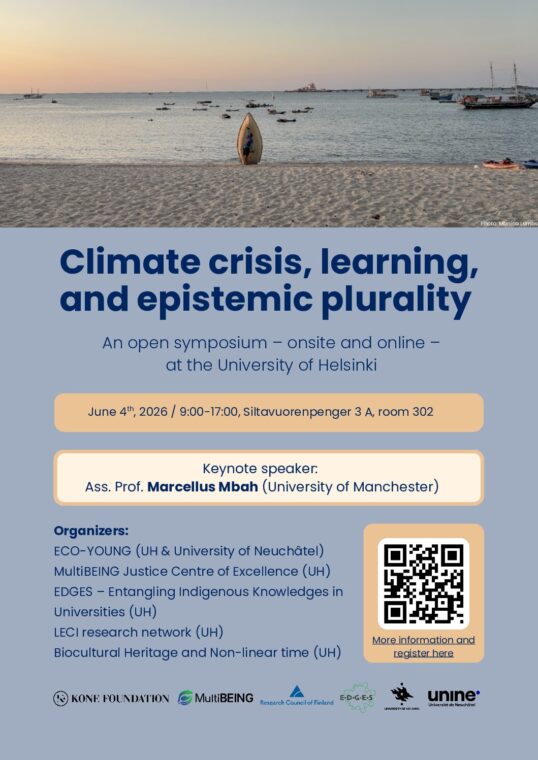
In recent years, scholars, Indigenous knowledge holders, and social movements have increasingly called for the decolonization of climate change discourses, addressing how dominant framings shape climate change related education, research agendas, curricula, and policy. It has been stated that the integration of epistemic plurality into global climate discussions is crucial for climate justice, as well as for climate adaptation and mitigation solutions. Thus, finding just solutions for the climate crisis requires broadening the focus from global Northern and capitalist ontologies towards other forms of knowledge and ways of learning.
Moreover, the multiplicity of the direct and indirect socio-political, cultural and environmental effects of climate change and its interconnections with learning vary significantly across different geographical, socio-cultural, historical, and epistemic contexts. Beyond Euro-centric knowledge and experiences, people learn to adapt to and mitigate the climate crisis through diverse knowledges and knowledge systems (Indigenous, religious, spiritual, territorial, ancestral, peripheral, etc.). In this cross-disciplinary symposium, we will discuss learning and education in the context of climate transformations across epistemic contexts.
Learning and education may take place in schools, homes, communities, religious and spiritual contexts, hobbies, activism, etc.The contributions pursue questions such as: What ontologies, epistemologies and values are present in understandings of the climate crisis and how they contribute to practical strategies, such as climate adaptation and mitigation at local levels? What role do emotions, senses, and other modes of knowledge production have in these processes? How do people navigate across different knowledge systems while making sense of climate-related issues in their lives? How do diverse power relations (socio-political, historical, epistemic) impact learning and education about climate change? And, what and how could these different knowledges and practices contribute to, or transform the political and/or educational discussions/policies/curricula in times of climate crisis and climate injustice?